Alameda Aesthetic Dentistry
What Is Root Canal Therapy? A Complete Guide for Patients in Alameda

Root canal. Two words that have carried an unfair reputation for decades. Most people who haven’t had one assume it’s among the worst dental experiences imaginable. Most people who have had one say it wasn’t nearly as bad as they expected and that the relief afterward made it entirely worth it. The reputation belongs to the era before modern anesthesia and digital dental technology. The procedure itself has changed considerably.
This guide is for patients in Alameda who are trying to separate fact from fear. Whether you’ve been told you need a root canal, you’re experiencing tooth pain and wondering what’s happening, or you simply want to know what the procedure involves before it becomes relevant to you, this walkthrough covers everything clearly and honestly.
What Is a Root Canal and Why Would You Need One?
A root canal is a dental procedure that removes infected or inflamed tissue from inside a tooth, cleans the internal canal system, and seals it to prevent reinfection. The name refers to the anatomy being treated: the root canals are the hollow passages inside each tooth root that house the pulp, a soft tissue containing nerves, blood vessels, and connective tissue.
When bacteria penetrate deep enough to reach this pulp through untreated decay, a crack, or a chip, infection develops. The inflammation creates pressure inside the tooth that has nowhere to go, which is what produces the throbbing pain patients often describe. Root canal treatment at Alameda Aesthetic Dentistry addresses this directly: the source of infection is removed, the pain resolves, and the natural tooth is preserved. The alternative – tooth extraction creates a gap that requires additional treatment to restore function and prevent shifting.
The most common reasons a root canal becomes necessary include deep cavities that weren’t caught early, repeated dental procedures on the same tooth, a crack or fracture that exposes the pulp, and trauma. In some cases, a tooth can require a root canal with no obvious symptoms — the infection is detected on an X-ray before pain develops.
What Happens During a Root Canal Procedure?
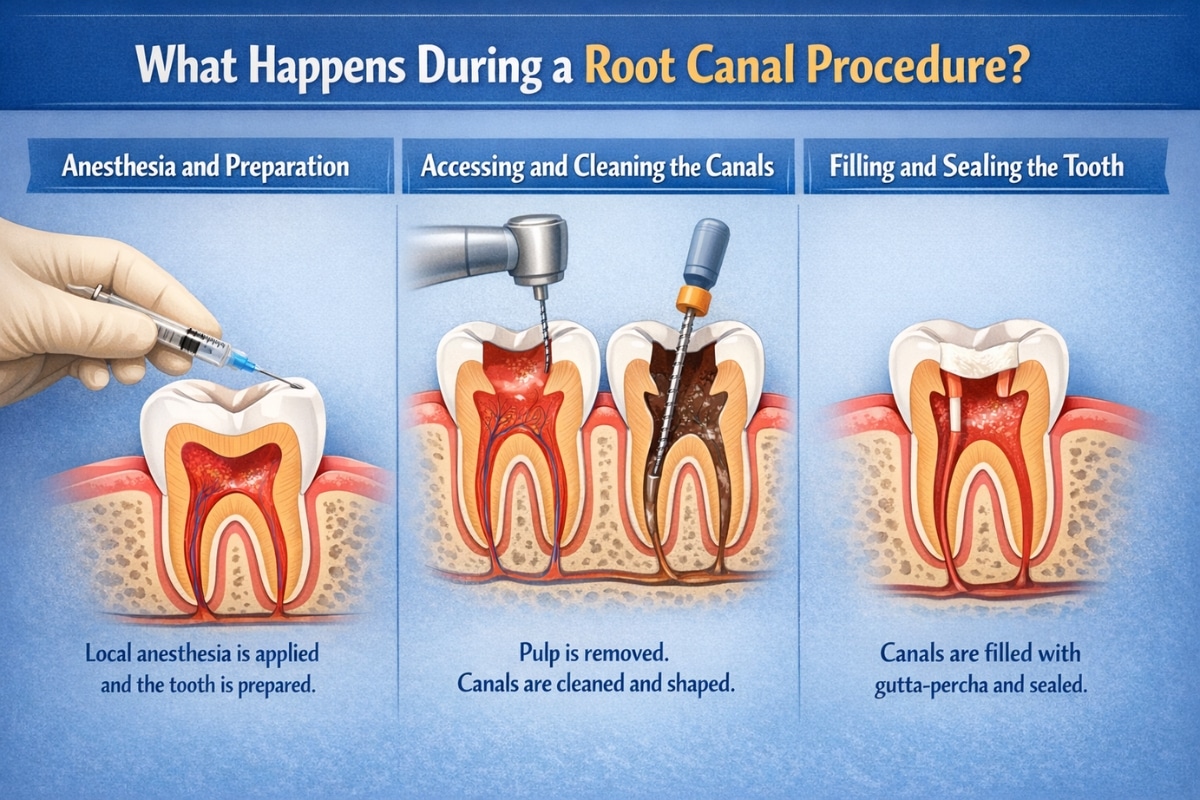
The root canal procedure follows a straightforward sequence. Knowing each step removes a lot of the anxiety that builds up in the waiting room. Here’s exactly what takes place:
Step 1: Anesthesia and Preparation
Your dentist administers local anesthesia to fully numb the tooth and surrounding tissue. At Alameda Aesthetic Dentistry, the WAND — a computer-controlled digital anesthesia delivery system is available for patients who experience anxiety around injections. It delivers an anesthetic more slowly and precisely than a traditional syringe, significantly reducing the discomfort of the numbing process itself.
Once you’re fully numb, a small rubber dam is placed around the tooth to keep it dry and free of saliva during the procedure. You should feel pressure throughout, but no sharp pain. If at any point you feel something uncomfortable, you can and should let your dentist know.
Step 2: Accessing and Cleaning the Canals
A small opening is made in the top of the tooth to access the pulp chamber. Fine instruments called endodontic files are used to remove infected or inflamed pulp tissue and to shape the canals, preparing them for filling. The canals are irrigated throughout this process with an antimicrobial solution (sodium hypochlorite) to flush out bacteria and debris.
The number of canals varies by tooth: front teeth typically have one, premolars have one or two, and molars commonly have three or four. This is why molar root canals take longer than those on front teeth and may occasionally require two appointments.
Step 3: Filling and Sealing the Tooth
Once the canals are fully cleaned and shaped, they’re filled with a biocompatible material called gutta-percha (a rubber-like compound) that seals the canals and prevents bacteria from re-entering. A temporary or permanent filling is then placed in the access opening.
In most cases, a dental crown is recommended after a root canal, particularly for back teeth. The root canal procedure removes the pulp, which means the tooth no longer receives the same internal nourishment. Over time, it can become more brittle and prone to fracture. A crown covers and protects the tooth, restoring its full biting function and longevity.
Root Canal Recovery Time: What to Expect After Treatment
Root canal recovery time is shorter than most patients expect. The majority of people return to their normal routine the following day. Here’s a realistic picture of what the days after treatment typically look like:
- Day 1: Some soreness and sensitivity in the treated area once the anesthetic wears off. This is normal and expected. Ibuprofen or acetaminophen manages it effectively for most patients.
- Days 2–3: The acute inflammation from the infection begins to resolve. Most patients notice a meaningful reduction in discomfort compared to their pre-treatment pain.
- Days 3–7: Residual tenderness, especially to biting pressure, typically fades during this window. Eating soft foods on the opposite side of the mouth is advisable until the crown is placed.
- From Week 2 onward, most patients are fully comfortable. The crown appointment is scheduled 2–4 weeks after the root canal to allow the tooth to fully settle.
If you experience worsening pain, swelling that grows rather than shrinks, fever, or the temporary filling comes loose, contact your dental office promptly. These are signals that warrant a follow-up, not a wait-and-see approach.
Signs You May Need a Root Canal
Not all of these symptoms confirm a root canal is necessary — only a clinical exam and X-rays can do that. But if you’re experiencing any of the following, it’s time to be seen rather than wait:
- Persistent, throbbing toothache that doesn’t respond to over-the-counter pain relief or gets worse at night
- Prolonged sensitivity to heat or cold that lingers well after the temperature source is removed
- Pain when biting or applying pressure to a tooth
- Visible darkening of a tooth relative to the surrounding teeth
- Swelling or a pimple-like bump on the gum near the base of a tooth, which may indicate an abscess
If you’ve been told you need a root canal, or you’re in pain and not sure what’s going on, the team at Alameda Aesthetic Dentistry is ready to evaluate your situation. Root canal treatment here is handled with the same attention to comfort and transparency that defines every procedure at the practice.
Don’t Wait on Tooth Pain — Get Seen Today
Tooth pain is your body’s way of flagging something that needs attention. A root canal, for all the anxiety surrounding it, is one of the most effective treatments in dentistry — it removes pain, saves the natural tooth, and prevents infection from spreading. The procedure itself is far more tolerable than the fear of it, and modern technology has made it more comfortable than ever.
Alameda Aesthetic Dentistry is accepting new patients and offers same-day evaluation for urgent dental concerns. Call 510-405-0070 or book your appointment online at alamedaaestheticdentistry.com.
People Also Ask
Is a root canal painful?
The procedure itself, performed under local anesthesia, should not be painful. You may feel pressure or vibration during treatment, but sharp pain indicates the area isn’t fully numb — and you should tell your dentist immediately if that happens. The soreness afterward is generally mild and manageable with over-the-counter medication. Most patients report that the pre-treatment toothache was far more painful than the procedure itself.
How long does a root canal appointment take?
Most root canals are completed in 60 to 90 minutes. Front teeth with a single canal are typically faster. Molars with three or four canals may take longer and sometimes require a second appointment to complete. Your dentist will give you a realistic time estimate based on which tooth is being treated and the complexity of your case.
Can a tooth that had a root canal get infected again?
Yes, though it’s uncommon when the treatment is done thoroughly, and the tooth is properly crowned afterward. Reinfection typically happens when a crown is delayed or fails, allowing bacteria to re-enter through a gap or new decay. In some cases, a procedure called an apicoectomy — a minor surgical procedure that removes the root tip — can address persistent or recurring infection.
Does dental insurance cover root canals?
Most dental insurance plans cover root canal therapy as a restorative procedure, typically at 50–80% after your deductible is met. Coverage may vary by tooth type — some plans cover anterior (front) teeth at a higher rate than molars. Alameda Aesthetic Dentistry works with Aetna, Delta Dental, Blue Cross Blue Shield, Cigna, MetLife, and other insurance providers. The team can verify your specific benefits before your appointment.
What happens if I delay a root canal?
A dental infection doesn’t resolve without treatment. Delaying a root canal allows the infection to spread — to surrounding bone, adjacent teeth, and potentially beyond the jaw. Left untreated, abscesses can become a serious systemic health concern. Beyond the health risks, delaying also increases the likelihood that the tooth becomes too damaged to save, making extraction the only remaining option.